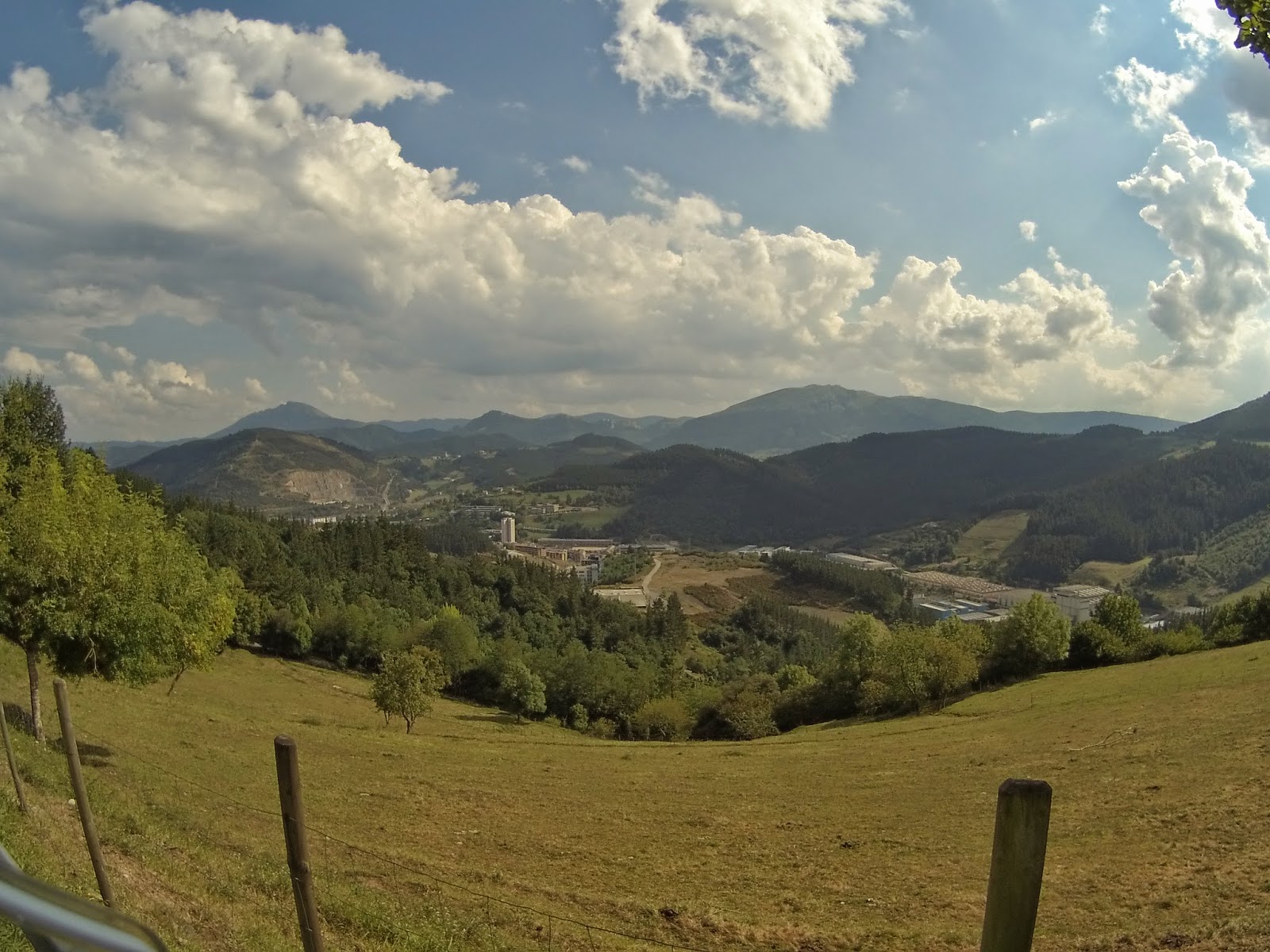
| View of Arrasate Mondragon. |
| Part of Mondragon |
![]() |
| I am happy here, Spain |
| View of Arrasate Mondragon. |
| Part of Mondragon |
![]() |
| I am happy here, Spain |
The teaching and learning environment in a foreign country, Mondragon University, Spain, is completely different from that in my country, Bhutan. I cannot say which one is better—the practice adopted in Bhutan or the practice adopted in Spain.
Learning takes place here because there is constant communication between tutors and students. Classes are friendly, and students can ask any question without hesitation. One interesting thing I have noticed is that students use personal computers (PCs) and utilize them very effectively. They use search engines like Google to find answers to questions. Tutors do not even come around to check whether students are using the PCs effectively—they trust their students very much.
In comparison, in Bhutan, there is little interaction between students and tutors. Students often hesitate to communicate with tutors, and the gap between students and tutors still exists. If students were given a chance to use PCs in a classroom with Wi-Fi available, I am sure many would misuse the platform (for example, Facebook). I admit that I even misused the platform here at Mondragon University, Spain.
Formality in the Classroom
In Bhutan, students maintain good decorum with tutors. They know how to respond to tutors respectfully.
In Spain, however, decorum is different. We can address our tutors by their first names, and the relationship is much less formal. Students show less outward respect toward tutors, at least in the way Bhutanese students do.
During my stay in Spain, I will learn about their culture and, if possible, adopt the best practices in our country.
Finally, a question to the reader: Which culture is better?
![]() |
| Mondragon University. |
It was 16:00 hours when I arrived in Spain (Mondragon University, MU) on 1st September. Miss Adrune, the international coordinator of the Interweave Project, guided me to reach my residence. There were two female students from MU who took me to my room and explained everything available in it: how to use the items in the room, where the toilet and bathroom were, where the sitting area was, and how to cook, all with their limited English.
I was alone in the room, as my three roommates—one from Slovakia and two from Italy—were yet to arrive on 3rd and 4th September, respectively. My friends from Bhutan and Nepal were living in different residences. The deepest sorrow of being alone in Spain, after traveling all the way from Asia (Bhutan), was something I could only describe as “My Nostalgia in Spain.” Tension after tension kept flowing nonstop. The language I speak was not understood by them, and the language they spoke was incomprehensible to me, creating a significant language barrier. The food they ate felt tasteless to me, and the food I was used to could not be found here. My nostalgia in Spain became even more intense as I deeply missed my loving parents. No matter how kind the people of Spain were or how hospitable they showed themselves to me, it could not replace the love and care my parents give me.
Although my mind was overwhelmed by “my nostalgia of Spain,” I still had deep faith in God Almighty, my only root teacher (Tsa-Wai-Lam), and gratitude toward my parents. I continued to follow my daily routine of praying in the morning and evening before bed.
To ease my nostalgia, I decided to visit my friends’ residences, where Keshav from Nepal and Anup Thapa, my friend from Bhutan, were staying. They were lucky enough to have a Spanish roommate named Joseba, who is pursuing a Master’s in Electrical Engineering. He helped us a lot. Thank you, Joseba—you are the first Spanish friend I added to my friend list after arriving here.